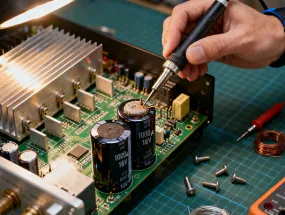
In switching power supplies, capacitors are essential for filtering ripple, storing energy, and stabilizing voltage across fast-switching circuits. Their performance directly affects efficiency, thermal behavior, startup response, and long-term reliability in industrial and electronic equipment. That is why understanding capacitor esr is critical for engineers and buyers who need stable power conversion, predictable lifetime, and dependable capacitor selection in demanding systems.
What Is Capacitor ESR?
Capacitor ESR means equivalent series resistance capacitor behavior represented as a small internal resistive element inside a real capacitor. In practical terms, no capacitor is ideal. Along with capacitance, every capacitor includes a certain amount of internal resistance caused by electrode materials, electrolyte conductivity, lead structure, winding design, and terminal connections.
This resistance matters because it generates heat when ripple current flows through the capacitor. The higher the ESR, the greater the power loss and internal temperature rise. In switching power supplies, where capacitors are repeatedly charged and discharged at high frequency, ESR directly affects ripple filtering, efficiency, stability, and service life.
For engineers, capacitor electrical parameters such as capacitance, ESR, ripple current, voltage rating, and lifetime must be evaluated together. A capacitor with the right capacitance but unsuitable ESR may still fail to meet system requirements. That is why capacitor esr is one of the most important real-world parameters in industrial power design.
How Capacitors Work in Switching Power Supplies
Switching power supplies are widely used in industrial automation systems, telecom equipment, EV charging modules, server power systems, LED drivers, and motor control electronics. In these systems, capacitors support multiple circuit functions from input filtering to output smoothing and transient energy support.
On the input side, capacitors help absorb line disturbances and reduce ripple after rectification. In intermediate DC bus stages, they store energy and stabilize voltage under changing load conditions. On the output side, they filter switching noise and support fast load response. Different capacitor types are used depending on circuit position, frequency, stress level, and cost target.
Aluminum electrolytic capacitors are common where high capacitance is needed for bulk storage and low-frequency ripple filtering. They are widely used in primary-side smoothing, DC link storage, and high-energy buffer sections. Film capacitors are often selected for high-frequency switching environments, snubber circuits, and applications that demand strong stability and long life. Ceramic capacitors are used for high-frequency decoupling and noise suppression because of their low impedance at high frequency.
In switching power supplies, capacitor selection depends on several key technical requirements. Voltage rating must cover working voltage plus expected margin. Ripple current capability must match actual current stress, because ripple heating is one of the main causes of capacitor aging. Lifetime rating is important because many power supplies operate continuously in warm environments. Temperature resistance also matters because internal power losses and ambient heat both affect capacitor life. Capacitance value determines energy storage and output stability, but it must be balanced with ESR and size.
Among these factors, capacitor esr has special importance because it links electrical and thermal behavior. A low-ESR capacitor reduces ripple voltage and internal heating. A high-ESR capacitor can cause excessive output ripple, poor transient response, reduced efficiency, and premature aging. This is especially relevant in compact power supplies where airflow is limited and thermal margin is small.
Parameter Table for Capacitors in Switching Power Supplies
| Parameter | Typical Range | Impact on System Design |
|---|---|---|
| Voltage Rating | 16V–1000V | Determines safety margin, insulation reliability, and long-term stability |
| Capacitance | 1µF–10000µF | Affects energy storage, ripple filtering, and hold-up performance |
| Ripple Current | 0.2A–20A+ | Influences heating, life expectancy, and current handling capability |
| ESR | Milliohm to several ohms depending on type | Directly affects ripple voltage, efficiency, and thermal loss |
| Temperature Resistance | -40°C to 105°C or higher | Critical for operation in industrial and enclosed environments |
| Lifetime Rating | 2000–12000 hours or more at rated temperature | Defines maintenance interval and long-term cost performance |
This table shows why capacitor electrical parameters must be considered as a complete group. A single specification alone does not determine suitability.
Why ESR Matters in Industrial Power Electronics
In real switching power supply design, ESR is not just a datasheet number. It is a major factor in circuit behavior and thermal reliability.
First, ESR affects ripple voltage. Ripple current flowing through internal resistance produces ripple voltage across the capacitor. If ESR is high, output noise and ripple increase, which can affect downstream control circuits, communication modules, sensors, and digital electronics. In precision industrial systems, this can create stability problems or reduced performance.
Second, ESR affects heat generation. Power loss inside the capacitor is proportional to ripple current squared multiplied by ESR. Even a moderate increase in ESR can lead to a significant temperature rise under heavy ripple conditions. That internal heat accelerates electrolyte evaporation in aluminum electrolytic capacitors and shortens useful life.
Third, ESR changes over time. As capacitors age, especially electrolytic types, ESR often increases. This means a capacitor that works well when new may gradually produce more heat and worse ripple filtering later in life. In industrial power supplies designed for continuous service, this long-term ESR drift is an important reliability consideration.
Fourth, ESR influences control loop performance. In some converter topologies, capacitor ESR contributes to output impedance and transient response. Too much ESR may worsen load-step behavior, while very low ESR can sometimes require compensation adjustments in control design. Engineers must therefore understand ESR not only as a reliability factor, but also as a circuit behavior parameter.
Because of these effects, the equivalent series resistance capacitor characteristic is especially important in systems such as industrial PLC power supplies, telecom rectifiers, embedded control power boards, and power modules for factory equipment. These applications often operate for long hours, under elevated temperatures, with limited maintenance access. Choosing the wrong ESR level can lead to field failures, unstable outputs, or excessive warranty cost.
Factors Affecting Capacitor Performance in Switching Power Supplies
Capacitor performance in industrial applications is shaped by the combined influence of electrical stress, thermal conditions, environment, and lifetime demands.
Electrical stress
Switching power supplies are exposed to input surges, switching spikes, inrush events, and repetitive ripple current. If the working voltage is too close to the capacitor limit, electrical stress increases and long-term reliability falls. Repetitive ripple current also raises internal temperature, especially when capacitor esr is too high for the application.
Thermal management
Heat is one of the biggest factors in capacitor aging. Internal heating comes from ESR loss, while external heating comes from nearby transformers, semiconductors, resistors, and confined enclosure design. In compact industrial power units, poor airflow can cause capacitor core temperature to remain high even when ambient temperature looks acceptable. Since capacitor lifetime decreases rapidly with temperature, thermal layout and ripple-current sizing are essential.
Environmental conditions
Humidity, vibration, dust, chemical exposure, and temperature cycling all affect capacitor reliability. In industrial automation systems, capacitors may operate in control cabinets, outdoor enclosures, or factory floors with high vibration and contamination. Screw terminal and snap-in electrolytic capacitors may need secure mounting and stronger mechanical stability in such environments. Film capacitors may be preferred in certain positions where endurance and robustness are more important than volumetric efficiency.
Reliability requirements
Industrial buyers often need predictable service life rather than lowest initial cost. The selected capacitor must match expected operating hours, maintenance cycle, and product warranty target. Tolerance stability, ESR drift behavior, ripple endurance, and manufacturer consistency all matter. In high-availability systems, low failure rate is often worth more than a lower component price.
These factors explain why capacitor selection in switching power supplies must go beyond nominal capacitance. Engineers need a complete view of capacitor electrical parameters and real operating conditions before approving a design.
Best Practices for Capacitor Selection
The first best practice is to apply voltage derating. Selecting a capacitor with adequate voltage margin improves reliability and helps absorb transient stress. Running too close to the rated voltage may reduce lifetime and increase failure risk, especially in unstable industrial mains environments.
The second best practice is to evaluate ripple current and ESR together. A capacitor with sufficient capacitance but poor ripple current capability may overheat. Engineers should check actual ripple conditions, not just nominal load current, and ensure the chosen part can handle long-term stress. Low ESR is especially important in output filtering and high-ripple positions.
The third best practice is to design for real temperature conditions, not room-temperature assumptions. Ambient cabinet temperature, heat from nearby power devices, and limited airflow can push capacitor temperature much higher than expected. Choosing a higher temperature grade or longer life series often produces better total cost performance than replacing failed parts later.
The fourth best practice is to match capacitor type to circuit function. Electrolytic capacitors are often ideal for bulk energy storage and DC smoothing. Film capacitors are often better for high-frequency stress, long life, and strong ripple performance in specific positions. Ceramic capacitors are valuable for local decoupling and noise filtering. Good industrial capacitor design uses each type where it adds the most value.
The fifth best practice is to work with reliable capacitor manufacturers. Consistent production quality, traceable materials, stable long-term supply, and accurate datasheet support all matter to engineers and procurement managers. A dependable supplier helps reduce risk in qualification, purchasing, and after-sales support.
Engineering Checklist for Capacitor Selection
- Verify real operating voltage, surge conditions, and required derating margin
- Confirm capacitance value based on hold-up time, ripple filtering, and transient needs
- Check capacitor esr against ripple voltage and heating targets
- Review ripple current rating under actual switching frequency and temperature
- Evaluate lifetime rating at realistic core temperature, not only ambient temperature
- Compare electrolytic, film, and ceramic options by circuit position
- Consider vibration, humidity, enclosure heat, and maintenance interval
- Confirm manufacturer quality consistency and long-term supply support
- Review ESR change over life when designing for industrial reliability
- Balance cost, performance, and expected service life before final approval
Practical Industrial Example
A manufacturer of DIN-rail switching power supplies for factory automation was facing field complaints related to unstable output voltage after long operating periods. The original design used standard aluminum electrolytic capacitors that met capacitance targets, but the ESR margin was insufficient under elevated cabinet temperature.
During redesign, the engineering team reviewed ripple current, thermal layout, and service conditions more carefully. They selected a higher-grade low-ESR electrolytic series for the output stage and adjusted spacing around hot power components to reduce thermal stress. In parallel, ceramic capacitors were added near critical control circuits to improve high-frequency noise suppression.
The result was a measurable reduction in ripple voltage and lower internal capacitor temperature during full-load operation. Product life improved, maintenance issues decreased, and procurement gained better confidence because the new capacitor series offered more stable supply and clearer lifetime data.
This example shows that equivalent series resistance capacitor behavior is not just theoretical. It directly affects system stability, field reliability, and total ownership cost in industrial electronics.
Conclusion
Capacitors are fundamental components in switching power supplies, where they support energy storage, ripple filtering, voltage stabilization, and transient response. In these systems, proper selection is essential because electrical stress, temperature, environment, and lifetime expectations all influence long-term reliability. Understanding capacitor electrical parameters helps engineers avoid underdesign, overheating, and premature failure.
Among all practical specifications, capacitor esr is one of the most important because it connects ripple performance, internal heating, efficiency, and service life. A well-selected capacitor with the right ESR, voltage rating, ripple current capability, and lifetime grade can improve output stability and extend equipment durability. For engineers, procurement teams, and industrial buyers, a strong understanding of capacitor esr leads to better design decisions, lower field risk, and more dependable switching power supply performance.
FAQ
What is the role of capacitors in switching power supplies?
Capacitors store energy, smooth rectified voltage, reduce ripple, support transient load response, and suppress noise in switching power supplies. Their selection directly affects efficiency and reliability.
Why is ESR important when selecting capacitors?
ESR affects ripple voltage, internal heating, efficiency, and capacitor life. A capacitor with unsuitable ESR can lead to higher temperature, worse filtering, and shorter service life.
What factors should be considered when choosing capacitors for industrial power equipment?
Engineers should consider voltage rating, capacitance, ripple current, ESR, temperature resistance, lifetime, environmental conditions, mounting style, and manufacturer consistency.