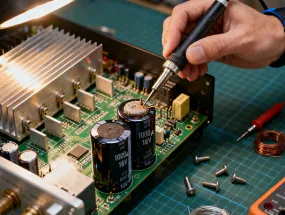
Using a capacitor with a higher voltage rating than required is generally safe, but it’s crucial to understand the trade-offs. This article explores the key risks and practical implications of opting for a higher-rated capacitor, helping you make an informed decision for your circuit.
Potential Consequences of Exceeding Capacitor Voltage Ratings
Hey there! If you’ve ever found yourself asking, “what are the effects of using a higher voltage capacitor?” or wondering about the implications of overrating a capacitor, you’re in the right place. It’s a common question, especially when you’re repairing something and the exact part isn’t available. The short answer is that using a cap with a higher WV (Working Voltage) rating than your circuit calls for is usually not a problem for the capacitor itself. In fact, it often adds a safety buffer. But—and it’s a big but—it’s not always the best choice. Let’s walk through what really happens so you can decide what’s right for your project.
5 Key Risks of Using a Higher Voltage Capacitor
While it’s typically safe, choosing a significantly higher-voltage component isn’t a free pass. Here are the five main downsides you should consider before making the swap.
Increased Physical Size and Board Space
This is the most immediate and obvious issue. A capacitor’s physical size is directly tied to its voltage rating and capacitance. For the same capacitance value (like 100µF), a 50V capacitor will be much larger than a 16V one. If you’re working on a crowded PCB, that extra bulk can be a real headache. You might find it simply doesn’t fit in the designated spot, forcing a messy redesign or an awkward mounting solution.
Higher Cost Without Performance Gain
Higher voltage ratings cost more money. You’re paying for more robust dielectric materials and construction. If your circuit only runs at 12V, splurging on a 63V rated electrolytic capacitor is an unnecessary expense. That money could be better spent elsewhere in your project. It’s like buying a heavy-duty truck for occasional grocery runs—it works, but it’s not cost-effective.
Potential Impact on Equivalent Series Resistance (ESR)
Here’s a more technical gotcha. For some capacitor types, particularly aluminum electrolytics, the Equivalent Series Resistance might be optimized for a specific voltage range. A part rated for a much higher voltage might have a different internal structure, leading to a higher ESR at your actual operating voltage. This can affect performance in power supply filtering or high-frequency applications. It’s not always the case, but it’s worth checking the datasheet if your circuit is sensitive.
Unexpected Reliability Concerns
This one sounds counterintuitive. Isn’t a higher rating more reliable? Usually, yes. But for electrolytic capacitors, there’s a nuance. These caps need a minimum voltage to properly form and maintain their oxide layer. If you use a 450V capacitor in a 5V circuit, it may never form correctly, which can lead to increased leakage current and a shorter operational lifespan than a properly rated cap. It’s a case of “too much of a good thing.
Circuit Performance Mismatch
Some circuits are designed with the characteristics of a specific capacitor in mind. For instance, in timing circuits or specific filter designs, the physical properties of a capacitor can influence behavior. While the capacitance value is key, the different physical construction of a high-voltage variant might introduce subtle shifts in performance. It’s rare, but in precision applications, it’s something to be aware of.
When Is It Actually Okay to Go Higher?
So, when is using a higher voltage rated capacitor a smart move? First, during repairs or prototyping when the exact part isn’t on hand. A common rule of thumb is to choose a replacement with a voltage rating at least 20-50% above the maximum voltage in your circuit. This provides a nice safety margin for voltage spikes. Second, in harsh environments where reliability is critical, that extra headroom can protect against transient overvoltage events. Just remember the trade-offs in size and cost we discussed.
Best Practices for Selecting Capacitor Voltage
To wrap up, here’s our friendly advice. Always start with the datasheet of your original component or your circuit’s design specs. Identify the maximum expected voltage—don’t forget to account for potential spikes! A good practice is to select a capacitor whose WV DC rating is 1.5 to 2 times that maximum. For example, in a 12V circuit, a 25V or 35V cap is a robust choice. For more detailed guidelines on capacitor ratings and safety, you can refer to resources from institutions like IEEE. The key is balance: enough safety margin without overdoing it on size and cost. Happy building!