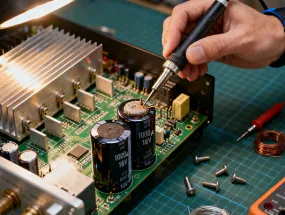
Ever wondered how your electronic devices get smooth, steady power? The secret often lies in power supply capacitors. These small but mighty components are the unsung heroes, quietly performing several critical jobs to keep everything running reliably. Let’s explore the five key roles they play.
Smoothing the Ripple: The Primary Filter
Think of the raw power coming from your wall outlet or a transformer like a bumpy, unpaved road. It’s full of peaks and valleys (we call this AC, or alternating current). Most of our gadgets need a smooth, flat road (DC, or direct current) to run on. This is the first and most famous job of a power supply capacitor. It acts like a shock absorber, soaking up the high points and filling in the low points of that electrical waveform. The result? A much smoother voltage that won’t cause your device to flicker or behave erratically. This process is often called ripple filtering or simply AC to DC filtering.
How Smoothing Works
Here’s a simple way to picture it: after the AC is converted to a pulsing DC signal by diodes (in a rectifier circuit), the large electrolytic capacitor charges up during the voltage peaks. Then, when the voltage dips, it quickly discharges, supplying energy to the circuit. This constant charge-and-discharge cycle fills in the gaps, ironing out the wrinkles in the power line. The larger the capacitor’s capacitance (measured in microfarads or µF), the more energy it can store for this smoothing job.
Acting as a Local Energy Reservoir
Even after smoothing, a power supply can’t always react instantly when a device suddenly needs a big burst of power—like when your amplifier hits a loud bass note. This is where capacitors shine as a local energy bank. You can think of them as a small battery sitting right next to the chip that needs power. When the circuit demands a quick spike in current, the main power supply might lag for a microsecond. The nearby bypass capacitor or bulk storage capacitor immediately releases its stored charge to cover that gap, preventing a momentary voltage drop that could cause a glitch or reset.
Decoupling and Noise Suppression
This role is a close cousin to being an energy reservoir, but it focuses on high-speed noise. Inside a complex circuit, different components can create electrical noise as they switch on and off rapidly. This noise can travel through the shared power lines and interfere with other sensitive parts. A decoupling capacitor (often a small ceramic capacitor) is placed very close to an integrated circuit’s power pin. It provides a very low-impedance path for this high-frequency noise to ground, effectively “decoupling” the noisy chip from the rest of the clean power supply. It’s like giving a chatty neighbor their own private soundproof room so the whole building stays quiet. For more on this concept, you can read about power integrity on resources like All About Circuits.
Aiding in Voltage Regulation
Voltage regulator ICs are designed to provide a rock-solid output voltage. But to do their best work, they prefer a relatively smooth input. A capacitor placed at the input of a voltage regulator helps ensure this by further reducing any leftover ripple from the main filter. More importantly, a capacitor at the regulator’s output is crucial. It stabilizes the output, improves the regulator’s ability to respond to sudden load changes, and can prevent potential oscillations. So, while the regulator is the boss setting the exact voltage, the capacitors are the essential assistants that keep the working environment stable.
Managing Inrush Current
When you first switch on a power supply, those big filter capacitors are completely empty. For a brief moment, they act like a short circuit, trying to suck in a huge surge of current to charge up. This inrush current can be many times higher than the normal operating current and can stress or even damage switches, fuses, and rectifier diodes. To tame this initial surge, engineers sometimes use a special soft-start circuit that often relies on strategically chosen capacitors to slowly ramp up the voltage, allowing for a gentle, controlled charge. It’s the electronic equivalent of slowly opening a water valve instead of slamming it full open.
So, the next time you use any electronic device, remember there’s a team of hardworking PSU capacitors inside. From smoothing rectified voltage to suppressing noise and providing instant power, these five roles are fundamental to the clean, reliable operation of virtually every modern power supply. Choosing the right type—like aluminum electrolytic for bulk storage or MLCC (Multi-Layer Ceramic Chip) for high-speed decoupling—is key to a great design.